
Understanding
Partial Knee
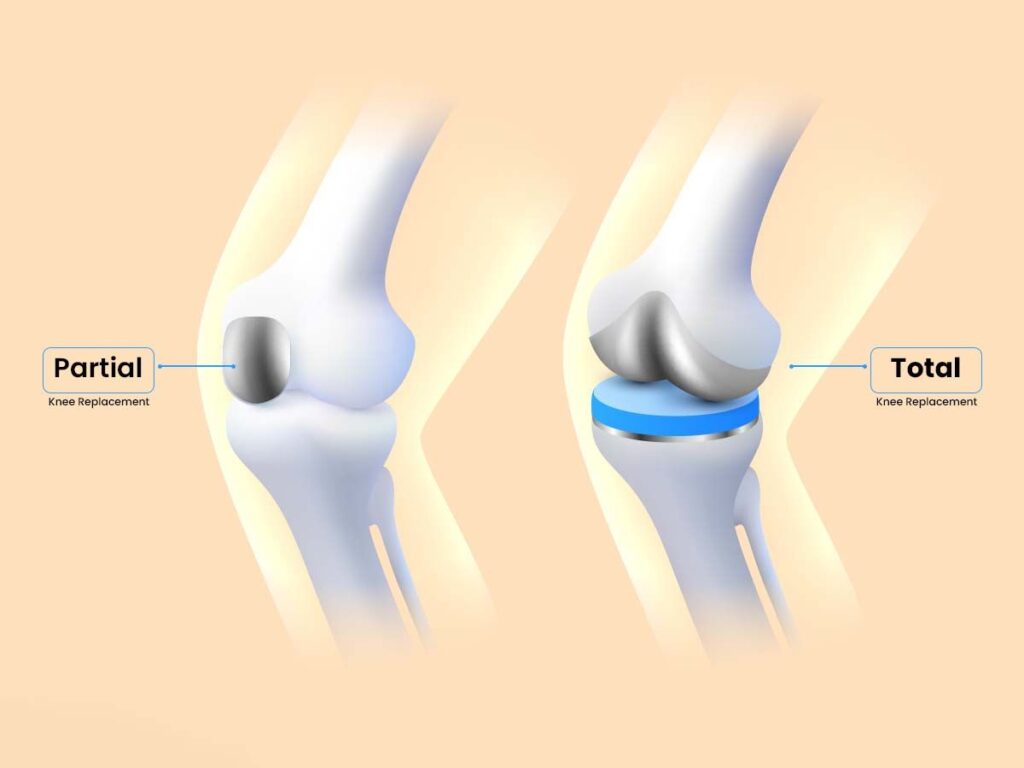
Partial Knee Replacement is a surgical procedure in which only the damaged part of the knee joint is replaced with an artificial implant, while the healthy parts of the knee are preserved.
It is also known as:
- Partial Knee Arthroplasty
- Unicompartmental Knee Replacement
This procedure is commonly recommended for patients with arthritis affecting only one part of the knee.
Anatomy of Partial Knee Replacement
- Femur – Thigh bone forming the upper knee joint
- Tibia – Shin bone forming the lower knee joint
- Patella – Kneecap protecting the knee
- Cartilage – Smooth cushioning tissue in the joint
- Ligaments – Support and stabilize the knee
- Meniscus – Shock-absorbing cartilage
- Partial Knee Implant – Replaces only the damaged compartment
Common Causes for Partial Knee Replacement
- Osteoarthritis in one compartment of the knee
- Knee cartilage damage
- Age-related joint wear and tear
- Previous knee injury
- Chronic knee pain
- Knee stiffness and swelling
- Difficulty walking or climbing stairs
- Failure of non-surgical treatments
Key Advantages of Partial Knee Replacement
significantly faster recovery times, less postoperative pain, and a more natural-feeling joint since healthy ligaments are preserved
- Faster Recovery: Rehabilitation takes roughly half the time of a total knee replacement. Most patients are up and walking within 24 to 48 hours and can resume routine daily activities within 2 to 3 weeks.
- More Natural Feel: Because only the damaged portion of the knee is resurfaced, the procedure preserves healthy bone, cartilage, and natural ligaments in the unaffected parts of the knee.
- Less Tissue Trauma: The surgery involves a smaller incision, requires less time under anesthesia, and results in significantly less blood loss compared to a full knee replacement.
- Reduced Pain: Less disruption to surrounding tissues and muscles translates to less pain during rehabilitation and a reduced need for strong pain medications.
- Improved Range of Motion: Preserving the natural structures of the knee often allows for better bending and overall flexibility compared to total joint replacements.
- Shorter Hospital Stays: Patients frequently experience a much shorter hospital stay, sometimes even returning home the same day.
When is treatment recommended?
- Pain limited to one part of the knee
- Difficulty walking or standing for long periods
- Knee stiffness affecting daily activities
- Swelling and discomfort in the knee
- Failure of medications and physiotherapy
- Early to moderate knee arthritis
- Reduced knee mobility
Why Choose Us for Partial Knee Replacement?
- Experienced orthopedic and joint replacement surgeons
- Advanced diagnostic and surgical technology
- Personalized treatment planning
- Minimally invasive surgical techniques
- Comprehensive rehabilitation support
- Advanced operation theatres and infrastructure
- Focus on faster recovery and pain relief
Frequently Asked Questions
Dr. Vishal Kasliwal is a leading orthopedic surgeon in Nashik with over 15 years of experience in joint replacement and arthroscopy surgeries. He has successfully performed more than 5,000 orthopedic procedures.
Kasliwal Hospital is centrally located on Gangapur Road, Nashik, offering advanced orthopedic care and specialized joint replacement services.
Kasliwal Hospital is Nashik’s only center exclusively performing Total Knee Replacement using the advanced Stryker Nav 3 Computer Navigation System, ensuring greater precision and improved surgical outcomes.
Kasliwal Hospital is Nashik’s only center exclusively performing Total Knee Replacement using the advanced Stryker Nav 3 Computer Navigation System, ensuring greater precision and improved surgical outcomes.
Oxford Partial Knee Replacement is a minimally invasive procedure that replaces only the damaged part of the knee while preserving healthy bone and ligaments, allowing for faster recovery and more natural knee movement.
Benefits may include:
- Smaller incision
- Less pain after surgery
- Faster recovery
- Shorter hospital stay
- More natural knee movement
- Preservation of healthy bone and ligaments
Recovery varies by patient, but most patients can resume daily activities within 4–6 weeks. Full recovery and rehabilitation may take several months depending on individual health and physiotherapy progress.
Yes, Kasliwal Hospital has a dedicated physiotherapy and rehabilitation team that supports patients before and after surgery to ensure optimal recovery.
Yes, joint replacement surgeries are highly successful procedures when performed by experienced orthopedic surgeons using advanced technology and proper post-operative care.
Patient Testimonials
Innovations That Move You Forward
Trustindex verifies that the original source of the review is Google. Posted on GoogleTrustindex verifies that the original source of the review is Google. Thank you Dr.Vishal sir, Best Hospital, Best tritment...Posted on GoogleTrustindex verifies that the original source of the review is Google. We recently underwent ACL surgery for my husband, Mr. Jitendra Jagtap, under the expert guidance of Dr. Vishal Kasliwal, and our experience has been truly exceptional. This was not our first experience with the hospital, as two years ago we had also undergone TKR surgery of my mother in law at the same hospital with the same doctor. Once again, the care, professionalism, and support exceeded our expectations. Dr. Vishal Kasliwal is undoubtedly one of the best orthopedic surgeons. His clarity in explaining every minute detail, his confidence in treatment, and his deep understanding of the condition provide immense reassurance to both the patient and family. Most importantly, he ensures that patients are emotionally satisfied and mentally prepared throughout the journey of recovery. A special mention to Mr. Pravin for his attentive nature and excellent hospitality support. He was always available and ensured that everything was managed smoothly and comfortably. We are truly grateful for the outstanding care and highly recommend Dr. Vishal Kasliwal and his team to anyone seeking orthopedic treatment. Thank you Vishal sir and team😊Posted on GoogleTrustindex verifies that the original source of the review is Google. One of the best orthopedics surgeon in North Maharashtra My mother underwent both knee replacement We were very happy to see her walk the very next day Dr is very kind and humble He guided us very patiently throughout the journey Now it is already 2 months post surgery and my mother is back on her toes walking trekking travelling and can do whatever she want like her knee pain never existed 🙏🙏 Thank You Dr Vishal Kasliwal Sir Grateful 🙏Posted on GoogleTrustindex verifies that the original source of the review is Google. Great Doctor team.very supportive all Doctor's and staff..Posted on GoogleTrustindex verifies that the original source of the review is Google. Posted on GoogleTrustindex verifies that the original source of the review is Google. Absolutely best treatment 🙌🏻Posted on GoogleTrustindex verifies that the original source of the review is Google. Vishal sir is very knowledgeable, humble and experienced person.....one of the best ortho surgeon not in the city but also in the state..... Hospital staff is very supportive.....Dr.Pravin sir is also very supportive and caring....Must visit if you have any Ortho related issues.....Posted on GoogleTrustindex verifies that the original source of the review is Google. Best orthopedic surgeon in the city.....guinune and humble person.....discuss every aspects truly.....give proper guidance and advice to the patient and relatives...Posted on GoogleTrustindex verifies that the original source of the review is Google. Dr. Vishal Kasliwal is an expert in replacement surgery in Nashik.Recently, I had a total knee replacement surgery.I had a very good experience and treatment from Dr. Vishal Sir.Cooperative, caring staff and a clean environment.I would like to give special thanks to Dr. Vishal and his staff. 🙏🙏🙏🙏🙏🙏